
Development Fills the Cahaba River with Sediment
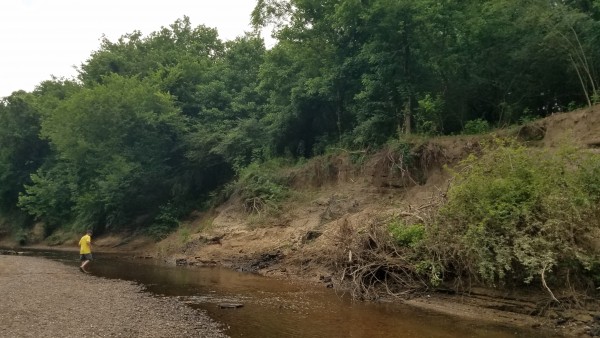
Riverkeeper David Butler walks along a section of the Cahaba River in Hoover that's been especially impacted by erosion and sediment loading.
Cahaba Riverkeeper David Butler often has to convince people that sediment can be a problem.
“You know rivers are remarkably resilient,” Butler says. “They can handle a normal amount of mud.”
But he says the amount of mud in the Cahaba is not normal. Walking along a section of the river in Hoover, Butler leans over and scoops up a handful of rocks.
“So if you see how much dirt there is in it,” he says, “there’s not a lot of space in between the rocks for bugs and mussels and snails to live.”

Mary Scott Hodgin, WBHM
In many parts of the Cahaba, the riverbed is muddy, where it used to be rocky.
Butler says it is now more common to see large mounds of dirt and gravel that pile up in the middle of the river, the result of sediment pushed downstream. Over the years, he says parts of the river and its tributaries have accumulated as much as 20 feet of extra sediment.
That makes it impossible for some aquatic life to survive, according to Randy Haddock, field director of the Cahaba River Society.
“Here is a list of some of the existing and some of the extirpated species that are federally listed as either threatened or endangered species on the Cahaba,” Haddock says, pointing to a list of about a dozen species. “All of them say it’s because of excessive sediment smothering their habitat.”
For example, Haddock says today’s population of mussels is about one-tenth of what it used to be. He says the animals naturally rest on a hard surface like rock, so large amounts of sediment increase their risk of sinking to the bottom of the river and filling with mud.
Beyond the loss of habitat and the decline in biodiversity, sediment increases the turbidity of water and can carry bacteria and metallic particles.
Haddock says the issue affects all residents of Birmingham, because the Cahaba is the city’s biggest source of drinking water and sediment is the biggest pollutant threatening that source.
“It’s a very different pollution problem,” he says, “in that you can’t point to a pipe with nasty stuff coming out of the pipe saying, ‘That’s poisonous, you need to limit how much of that comes out.’”
Haddock says most of the sediment in the Cahaba comes from erosion along the riverbank, caused by increasing volumes of stormwater runoff. The issue largely stems from development upstream, and the impact can be seen over decades.
Another more immediate problem happens during construction. When land is first disturbed, trees are cut down and bulldozers roll in, exposed dirt and gravel can wash into nearby streams. UAB engineering professor Wesley Zech says this is a problem across the U.S.
“Currently, research has shown there’s 80 million tons of sediment that is discharged into our nation’s water bodies from construction sites every year,” Zech says.

David Butler, Cahaba Riverkeeper
Sediment barriers fail to control rainwater on a construction site.
Developers and builders in Alabama are required to prevent this via permits issued by local governments and the Alabama Department of Environmental Management (ADEM).
But activists like Randy Haddock say there is not enough oversight and enforcement of these regulations.
“To actually levy a fine against somebody for allowing sediment to come off their construction site is a byzantine process,” Haddock says.
In 2018, ADEM issued 23 penalties statewide against builders for land disturbance violations like failing to control sediment. Haddock and Cahaba Riverkeeper David Butler say that number represents a fraction of actual violations.
On the other hand, construction workers say it can be difficult to keep all the dirt contained on a site, especially in Alabama where the land can be hilly and it rains a lot.

Mary Scott Hodgin, WBHM
Site planners and designers participate in a workshop about sediment and erosion control.
This was part of the discussion at a recent workshop in Pelham, where site planners and designers learned the latest research on sediment and erosion control. They reviewed which fabric is best for a silt fence and when to use other barriers. Workshop attendee Phillip Voss, division permit manager with a Texas-based construction company, says when trying to control sediment, every site presents different challenges.
“One thing that we promote right now is ‘be the water, think about where the water’s going.’” Voss says. “Because not only are you trying to manage that water, but you’ve got to manage the quality of that water.”
Engineering professor Wesley Zech says these controls aren’t new.
“They’ve been used for quite a long time,” he says. “But now we see it’s becoming more of a priority.”
Zech says that’s because the impacts of sediment pollution are becoming more evident.
A few years ago, a state environmental study recommended reducing the amount of annual sediment loading in the Cahaba by around 50%. Construction is just the beginning. Experts say to really see progress, developers have to change not only how they build, but how they design, from the ground up.
Editor’s Note: The Cahaba River Society is a member sponsor of WBHM, but our business and news departments operate separately.

Crew of fatal US military crash included Alabama father recently deployed
The six U.S. service members who died in the crash of a U.S. military refueling aircraft included an Alabama father who had just been promoted and deployed. The U.S. government released the identities of the deceased service members Saturday.
Alabama poised to drastically overhaul utility regulation. Will it lower electric bills?
The Alabama Senate unanimously voted to expand the public service commission, and create a Secretary of Energy to address rising electricity prices. A bill in the House would go even further, requiring rate case hearings and limiting utility profits.

Musher from Alabama is going for back-to-back Iditarod wins
Riches and paid appearances haven’t followed Jessie Holmes since he won the world’s most famous sled dog race, the Iditarod, last year. He doesn't mind.

Bill would move Alabama to closed primaries
Right now, any Alabama voter can participate in a primary election. Lawmakers in Montgomery took up a bill this week that would change that system.
Auburn football player uses NIL funds to open a community hub in Birmingham
Jourdin Crawford, a freshman defensive lineman at Auburn, used earnings from a Name, Image, and Likeness deal to give back to his hometown.

Ivey commutes death sentence of inmate whose accomplice fired fatal shot
Charles “Sonny” Burton was sentenced to death for the killing of Doug Battle during a 1991 robbery. However, another man shot Battle when Burton had left the building.