
Alabama’s racial, ethnic health disparities are ‘more severe’ than other states, report says
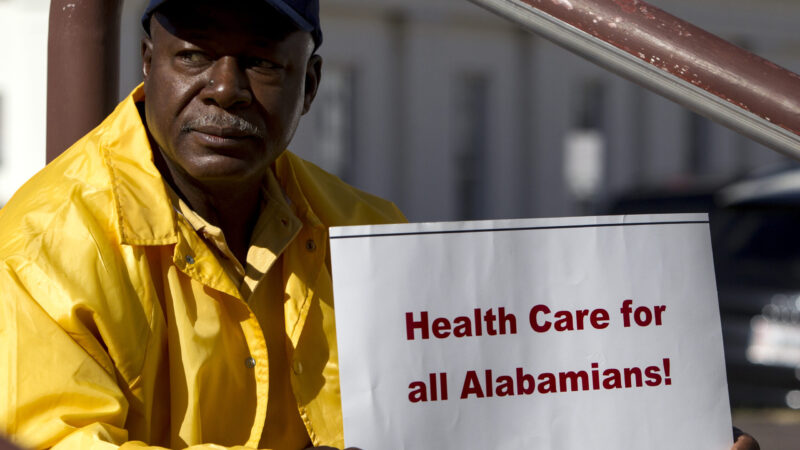
In this file photo, Jerry Burnet, of Huntsville, Ala., holds up a sign in support of the expansion of Medicaid in front of the State House as the first day of the Alabama Legislature begins on Tuesday, Jan. 14, 2014, in Montgomery, Ala. (AP Photo/Butch Dill)
Across the South, there are deep-seated racial and ethnic disparities in people’s health, their access to health care and the quality of care they receive, according to a new report from the Commonwealth Fund, a foundation that’s focused on improving the health care system in the United States. The report also highlights a stark racial divide in premature deaths.
The report offers a comprehensive analysis of how health care systems function for people in every state, evaluating disparities for Black, white, Hispanic, American Indian and Alaska Native (AIAN) and Asian American, Native Hawaiian and Pacific Islander (AANHPI) populations, both within and between states. As part of the Commonwealth Fund’s ongoing series examining state health system performance, the report uses 25 measures to produce a “score” that evaluates states on health care access, quality, service use, and health outcomes for these groups.
The data show that the quality of care people receive and their health outcomes worsened nationwide because of the COVID-19 pandemic. It also shows that many people are dying younger than they should — a term known as “avoidable death,” which includes deaths from preventable and treatable causes — because of health problems or because of inadequate medical care.
This is especially true in the Gulf South.
“Fundamentally, we do see those states as having lower performance around some key health care measures,” said Joseph Betancourt, the president of the Commonwealth Fund. “We do see greater disparities in the Gulf states when compared to some other states with poor performance for communities of color.”
Here is a quick overview of how Alabama, Louisiana and Mississippi performed:
Alabama
For Alabama, the data show white people experiencing the highest health system performance, scoring in the 61st percentile among all groups nationally.
Hispanic people experienced the lowest in the state, scoring in the 8th percentile.
“Compared to other states in the Southeast region,” the report states, “Alabama has more severe racial and ethnic health disparities.”
Louisiana
In Louisiana, white people experienced the highest health system performance — a metric composed of 25 different variables — scoring in the 63rd percentile among all population groups nationally.
Hispanic people experienced the lowest in the state, scoring in the 21st percentile.
The state ranked “worse than average” for all racial and ethnic groups where there was enough data.
Mississippi
The report found that Black people in Mississippi experienced the lowest health system performance in the state, scoring in the 5th percentile. This was also the worst performance for Black people in all states where calculation was possible.
White people experienced the highest health system performance score, landing in the 37th percentile among all population groups nationally. The state, however, ranks dead last in states where the calculation was possible, indicating that the health system performance for white people in the state was among the worst compared to other states.
Policy change can bridge the gap
The report makes several recommendations to address the disparities, with ensuring universal, affordable and equitable health coverage being chief among them.
This can be achieved through policies such as permanently extending the enhanced marketplace premium subsidies set to expire in 2025, expanding Medicaid programs in the 10 states that have failed to do so and reducing deductibles and out-of-pocket costs for marketplace insurance plans, the report suggests.
Other recommendations include strengthening primary care and improving the delivery of services, reducing inequitable administrative burdens affecting patients and providers and investing in social services.
For more, read the full report here.
This story was produced by the Gulf States Newsroom, a collaboration between Mississippi Public Broadcasting, WBHM in Alabama, WWNO and WRKF in Louisiana and NPR. Support for health equity coverage comes from The Commonwealth Fund.

Crew of fatal US military crash included Alabama father recently deployed
The six U.S. service members who died in the crash of a U.S. military refueling aircraft included an Alabama father who had just been promoted and deployed. The U.S. government released the identities of the deceased service members Saturday.
Alabama poised to drastically overhaul utility regulation. Will it lower electric bills?
The Alabama Senate unanimously voted to expand the public service commission, and create a Secretary of Energy to address rising electricity prices. A bill in the House would go even further, requiring rate case hearings and limiting utility profits.

Musher from Alabama is going for back-to-back Iditarod wins
Riches and paid appearances haven’t followed Jessie Holmes since he won the world’s most famous sled dog race, the Iditarod, last year. He doesn't mind.
Bill would move Alabama to closed primaries
Right now, any Alabama voter can participate in a primary election. Lawmakers in Montgomery took up a bill this week that would change that system.
Auburn football player uses NIL funds to open a community hub in Birmingham
Jourdin Crawford, a freshman defensive lineman at Auburn, used earnings from a Name, Image, and Likeness deal to give back to his hometown.
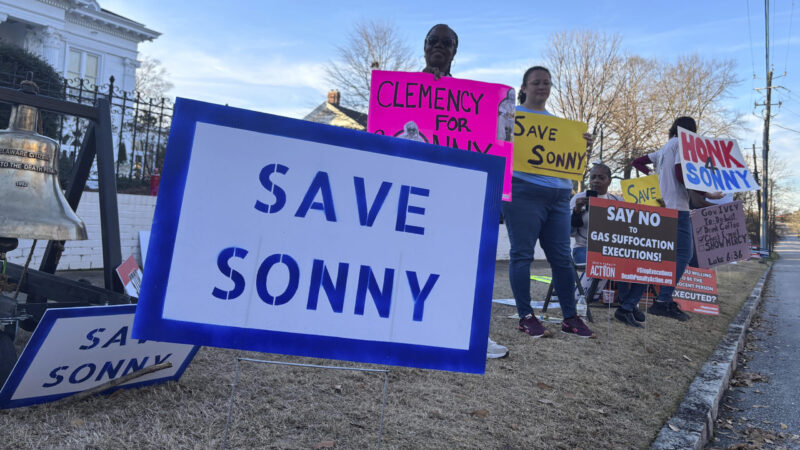
Ivey commutes death sentence of inmate whose accomplice fired fatal shot
Charles “Sonny” Burton was sentenced to death for the killing of Doug Battle during a 1991 robbery. However, another man shot Battle when Burton had left the building.