
Supreme Court to decide whether Alabama can postpone drawing new congressional districts
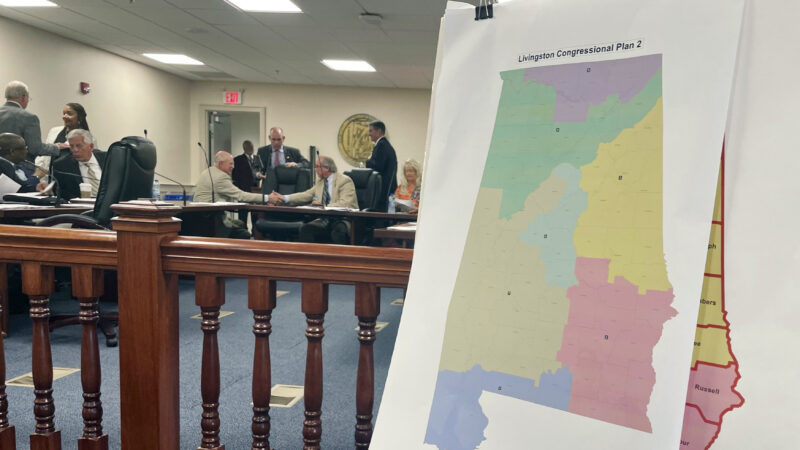
A map of a GOP proposal to redraw Alabama's congressional districts is displayed at the Alabama Statehouse in Montgomery, Ala., Tuesday, July 18, 2023.
MONTGOMERY, Ala. (AP) — The U.S. Supreme Court is expected to soon rule on Alabama’s request to let it keep new GOP-drawn congressional lines in place as it fights a three-judge panel’s plan to create a second majority-Black district, or something close to it, in the Deep South state.
The state attorney general and lawyers representing Black voters who challenged the map gave different interpretations in court fillings this week of whether Alabama blatantly defied justices’ June decision in the case. The outcome could determine what map the state uses in the 2024 elections and whether the high court will revisit arguments over the role of race in redistricting.
A three-judge panel is drawing new congressional lines in Alabama after lawmakers refused their directive to create a second district where Black voters would at least come close to comprising a majority. The Alabama secretary of state last week asked justices to put the redrawing process on hold as the state appeals.
Lawyers representing plaintiffs in the case said Alabama “knowingly and intentionally” defied court orders and passed a map that continued to dilute the influence of Black voters in congressional elections. Plaintiffs have likened the state’s action to how Alabama leaders fought court-ordered integration in the 1960s. A decision to review the case — even if Alabama ultimately loses — could keep GOP-drawn lines in place for another election cycle.
“There is too much at stake. The government is supposed to represent the people. Yet we are being robbed of representation at the highest level,” Evan Milligan, the lead plaintiff in the lawsuit, said Thursday.
The issue is back before the Supreme Court just three months after justices ruled against the state in a 5-4 decision and upheld the three-judge panel’s finding that the state’s 2021 map — which had one majority-Black district out of seven in a state where more than one in four residents is Black — likely violated the Voting Rights Act.
The three-judge panel said any new map should include a second majority-Black district or “something quite close to it” so that Black voters “have an opportunity to elect a representative of their choice.” The Republican-controlled Alabama Legislature in July adopted a plan that maintained a single Black district, but boosted the percentage of Black voters in another to about 39%. The three-judge panel wrote that they were “deeply troubled” by the state’s defiance, blocked use of the new map and directed a special master to submit proposed new maps by Monday.
Alabama maintains that the June Supreme Court ruling in the case did not necessarily require a remedy of a second minority district. Alabama contends that its new map fixes the problems identified by the court such as how the state’s Black Belt region was split into multiple districts.
“The 2023 map cures those defects, but because it doesn’t guarantee a second safe seat for Democrats, Plaintiffs now demand racial discrimination. … The VRA does not require this sort of racial sorting of voters, and the Constitution does not allow it,” the Alabama attorney general’s office said in a statement.
Alabama, in seeking a reversal of fortune, cited the recent Supreme Court ruling striking down affirmative action in college admissions, writing “just as this Court held that race-based affirmative action in education at some point had to end, the same principle applies to affirmative action in districting.”
Kareem Crayton, a redistricting expert with the Brennan Institute for Justice, which earlier filed a brief supporting plaintiffs in the case, said Alabama appears to be attempting to get the court to revisit what is required of Section 2 of the Voting Rights Act. “They have made the argument — and it really is nonsensical — that we don’t want to think about race (in) the matter of drawing districts. That’s not even consistent with their own practice,” Crayton said.
The three-judge panel said Alabama should have a second district that provides Black voters with a reasonable “opportunity” to elect their preferred candidates.
Alabama’s plan boosts the percentage of Black voters in the 2nd District, an area with deep ties to agriculture and home to a military base, from about 30% to almost 40%. But Crayton said an analysis of recent elections shows that a candidate preferred by Black voters would still lose almost every election in that district.
“It’s an opportunity for Republicans to keep control,” Crayton said.

Crew of fatal US military crash included Alabama father recently deployed
The six U.S. service members who died in the crash of a U.S. military refueling aircraft included an Alabama father who had just been promoted and deployed. The U.S. government released the identities of the deceased service members Saturday.
Alabama poised to drastically overhaul utility regulation. Will it lower electric bills?
The Alabama Senate unanimously voted to expand the public service commission, and create a Secretary of Energy to address rising electricity prices. A bill in the House would go even further, requiring rate case hearings and limiting utility profits.

Musher from Alabama is going for back-to-back Iditarod wins
Riches and paid appearances haven’t followed Jessie Holmes since he won the world’s most famous sled dog race, the Iditarod, last year. He doesn't mind.
Bill would move Alabama to closed primaries
Right now, any Alabama voter can participate in a primary election. Lawmakers in Montgomery took up a bill this week that would change that system.
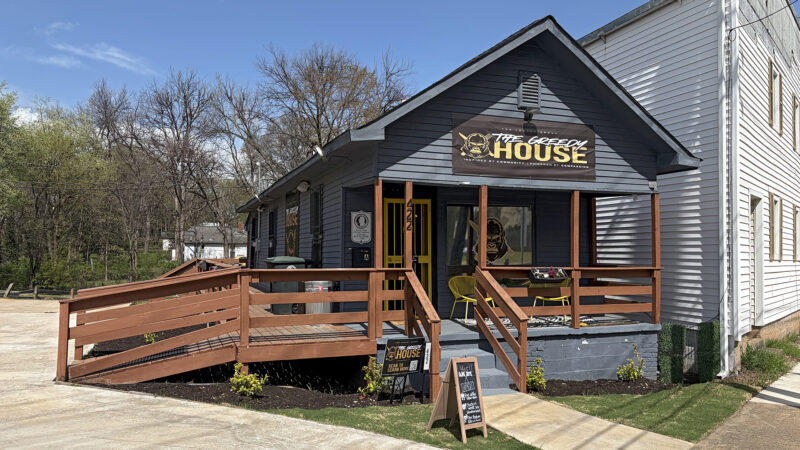
Auburn football player uses NIL funds to open a community hub in Birmingham
Jourdin Crawford, a freshman defensive lineman at Auburn, used earnings from a Name, Image, and Likeness deal to give back to his hometown.
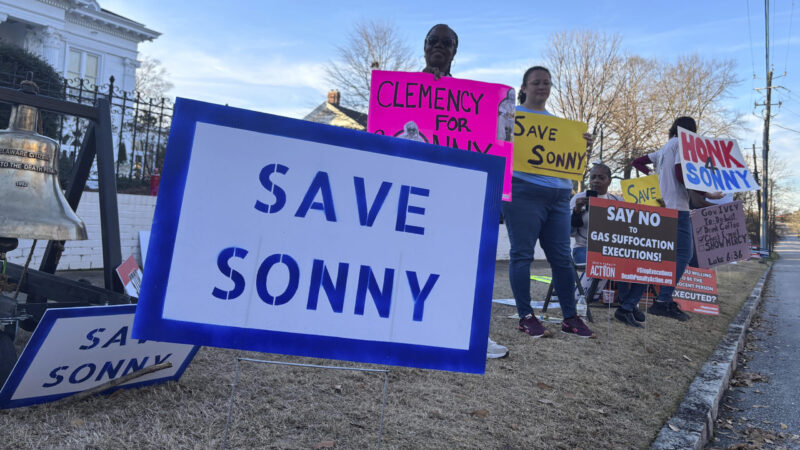
Ivey commutes death sentence of inmate whose accomplice fired fatal shot
Charles “Sonny” Burton was sentenced to death for the killing of Doug Battle during a 1991 robbery. However, another man shot Battle when Burton had left the building.