
Lawmakers wrap up special session on COVID relief funds
Alabama lawmakers approved spending more than $1 billion in funds from the American Rescue Plan Act (ARPA), federal monies intended to help rebuild from the pandemic, in a special session that ended Thursday. The money mostly goes to broadband expansion, water and sewer infrastructure and reimbursements to health care facilities.
“Alabama can now look to a future of greater promise thanks to the steps we have taken this week to invest these funds wisely,” Gov. Kay Ivey said in a statement after signing the bill into law hours after the special session ended.
Legislators were mostly in lockstep through the process, but they did make a few tweaks as the legislation made it to the finish line.
Todd Stacy, host of Capitol Journal on Alabama Public Television, offered more details in this week’s legislative update.
Final tweaks
The plan allocates $400 million for water and sewer projects. A Senate committee expanded how that money could be used.
First, Republican Sen. Chris Elliott of Daphne pushed to require $100 million of that money be eligible to local governments that put up 35% percent in matching funds.
“Elliott has argued that not all of the funds should go toward only impoverished, rural areas as the first round of ARPA funds did,” Stacy said. “He represents an area in Baldwin County that’s rapidly growing. He says growing communities deserve to be eligible for some of that money.”
A second key change came with backing from Democratic Sen. Linda Coleman-Madison of Birmingham and others who represent cities. It would allow $200 million to be eligible for stormwater drainage projects.
“It’s a huge issue in Birmingham. It’s a huge issue, really, in all the cities,” Stacy said.
While the spending package passed with little opposition, Stacy said Republican Sen. Arthur Orr of Decatur voted against it, which is notable because he’s chair of a budget committee and helped craft this plan.
Orr objected to the fact there was only about $40 million appropriated to the Public Education Employees’ Insurance Plan, which provides health insurance for teachers. The program had incurred around $100 million in COVID expenses.
“Orr said, ‘Look, that’s what this money is supposed to be for,’” Stacy said. “He objected to the point where he voted no.”
Overall, the final spending plan will allocate:
— $339 million for health care costs, including $100 million to reimburse hospitals for pandemic-related expenses, $100 million to reimburse nursing homes and $25 million to support mental health programs and services.
— $400 million for water and sewer infrastructure projects, including $195 million for high-need projects, $200 million for matching funds for public water and sewer systems, and $5 million for septic systems in the Black Belt region.
— $260 million for improvement and expansion of broadband network access.
— $55 million for projects that address economic impacts of the pandemic. The legislation says the Department of Finance may distribute the money for a wide range of needs such as food banks, long-term housing and summer learning programs for children.
State sales tax on groceries
Alabama lawmakers have talked for at least two decades about exempting groceries from the state’s 4% sales tax. Most states don’t levy sales tax on groceries or do so at a lower amount. Despite support for the idea from a variety of constituencies, a proposal has never made it into law.
“Those taxes go into the Education Trust Fund,” Stacy said. “So to cut that tax is to essentially cut the amount of money going to pay teachers and fund schools. So nobody wanted to do that.”
But with revenues unusually high, lawmakers are giving more serious consideration to the idea.
One part of a plan to exempt state sales tax from groceries might include ending Alabama’s state income tax deduction for federal income taxes paid. This is a tax break that tends to benefit wealthier taxpayers. Stacy doesn’t expect the deduction to be eliminated completely, but possibly for higher earners.
Orr is expected to bring forward a proposal that would lower the sales tax on groceries by 1% a year over four years.
Stacy said a novel approach comes from House Minority Leader Anthony Daniels of Huntsville. He suggested doing a one-month tax holiday on groceries and then comparing that month to the one a year ago to see if there is a revenue shortfall.
“His argument is he doesn’t think there will be,” Stacy said. “I think that might be an interesting approach because it’s allowing the state to kind of test the waters.”
The regular legislative session resumes on Tuesday.
Includes reporting from the Associated Press
Crew of fatal US military crash included Alabama father recently deployed
The six U.S. service members who died in the crash of a U.S. military refueling aircraft included an Alabama father who had just been promoted and deployed. The U.S. government released the identities of the deceased service members Saturday.
Alabama poised to drastically overhaul utility regulation. Will it lower electric bills?
The Alabama Senate unanimously voted to expand the public service commission, and create a Secretary of Energy to address rising electricity prices. A bill in the House would go even further, requiring rate case hearings and limiting utility profits.

Musher from Alabama is going for back-to-back Iditarod wins
Riches and paid appearances haven’t followed Jessie Holmes since he won the world’s most famous sled dog race, the Iditarod, last year. He doesn't mind.
Bill would move Alabama to closed primaries
Right now, any Alabama voter can participate in a primary election. Lawmakers in Montgomery took up a bill this week that would change that system.
Auburn football player uses NIL funds to open a community hub in Birmingham
Jourdin Crawford, a freshman defensive lineman at Auburn, used earnings from a Name, Image, and Likeness deal to give back to his hometown.
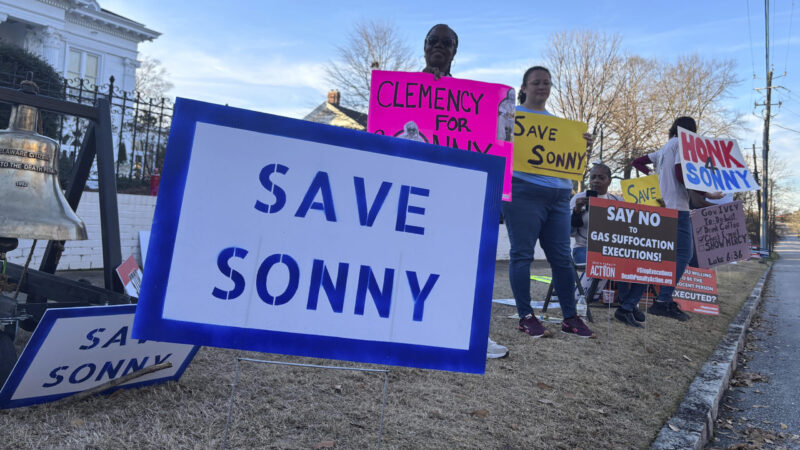
Ivey commutes death sentence of inmate whose accomplice fired fatal shot
Charles “Sonny” Burton was sentenced to death for the killing of Doug Battle during a 1991 robbery. However, another man shot Battle when Burton had left the building.