
Supreme Court lets Alabama use GOP-backed map of the state’s congressional districts
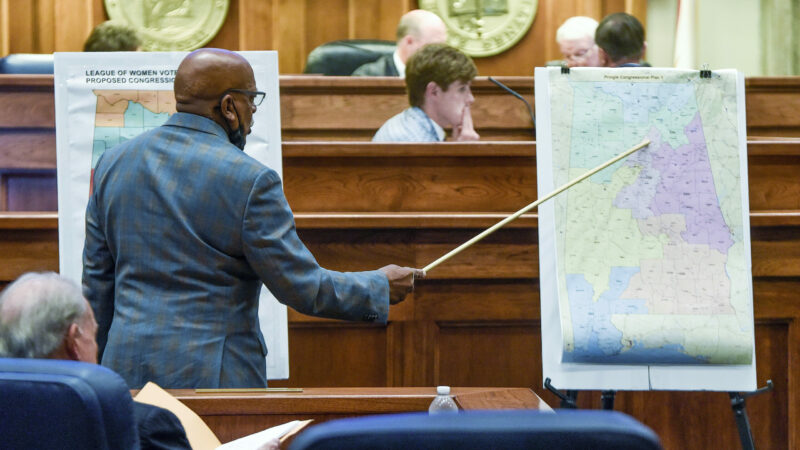
Sen. Rodger Smitherman compares U.S. Representative district maps during a special session on redistricting at the Alabama Statehouse in Montgomery, Ala., Nov. 3, 2021.
By Nina Totenberg, NPR
The U.S. Supreme Court further undercut the Voting Rights Act on Monday, blocking, for now, the creation of a second majority-Black congressional district in Alabama for the 2022 election.
The court’s action came on an emergency appeal from Alabama, which challenged a decision by a three-judge federal court panel that included two Trump appointees. The lower court concluded that under the Voting Rights Act, Alabama, a state with a population that is more than one-quarter Black, could reasonably, and therefore must, create two majority-Black districts out of seven congressional districts.
The Supreme Court vote was 5-4, with Chief Justice John Roberts joining the court’s three liberals in dissent. All four would have refused to intervene now, thus allowing the 2022 election to go forward with a map calling for two majority-Black districts. In contrast, the five-justice majority decision means that for at least another election cycle, Alabama will have just a single majority-Black congressional district, because the primaries are set to take place in May.
While the court has said that outright racial gerrymanders are unconstitutional, it has long interpreted the Voting Rights Act as requiring race to be a major factor in redistricting under certain circumstances — namely when white voters vote as a bloc against Black candidates and when a compact-enough majority-minority district or districts can be drawn so that minorities have a good chance to elect the candidates of their choice.
In the case from Alabama, the state doesn’t dispute that there is bloc voting. But it contests the creation of a second majority-Black district because it would divide the suburbs of Mobile. That argument was rejected by the lower court, which noted that the school districts in that area were divided in precisely the same way as the proposed second majority-Black congressional district.
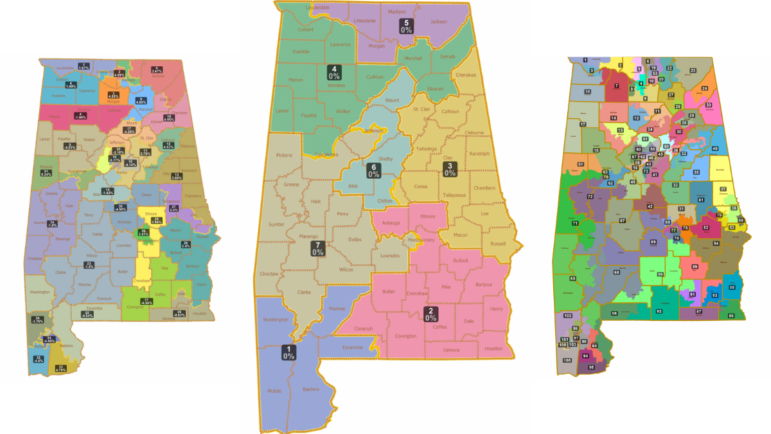
But the Supreme Court stopped the lower court’s order from going into effect.
Alabama Attorney General Steve Marshall proclaimed victory for now, declaring that the creation of a single majority-Black district is all that the Constitution demands.
Needless to say, the Black plaintiffs were disappointed. Plaintiff Evan Milligan said in a statement on Monday: “We are disappointed by today’s decision. The fight for fair representation for Black voters in Alabama has been a winding road, generations long. However, during a month set aside to honor Black American history, we are reminded of the strength and dignity displayed by our ancestors who routinely confronted a wide variety of disappointments.”
Once again, the court’s action came in an unsigned order, without full briefing or argument, though the court will eventually hear arguments in the case, either later this term or, more likely, next fall.
“Accepting Alabama’s contentions would rewrite decades of this Court’s precedent” about the Voting Rights Act, wrote Justice Elena Kagan in a dissent joined by Justices Stephen Breyer and Sonia Sotomayor. “Here the district court applied established legal principles to an extensive evidentiary record. It’s reasoning was careful — indeed exhaustive — and justified in every respect,” and to do this on the court’s “shadow docket” without full briefing and argument first “does a disservice to Black Alabamians who … have had their electoral power diminished — in violation of a law this Court once knew to buttress all of American democracy.”
Chief Justice Roberts dissented separately, saying that because the lower court followed established precedents, he would not intervene to block the order. But he also suggested that the existing precedents are ambiguous and confusing, and he therefore voted to hear arguments on the wisdom of those precedents.
In a concurring opinion, Justice Brett Kavanaugh sought to justify the majority’s position, maintaining that the “stay order does not make or signal any change to voting rights law.”
Election law expert Rick Hasen, of the University of California, Irvine, however, saw the decision as telegraphing what “could be a radical reworking of the Voting Rights Act that would decrease minority representation, especially in the South.”
The court did not say when it will hear arguments in the case — and so the current GOP-drawn map, which has only one majority-minority district, will almost certainly remain in effect at least for the 2022 election and very likely beyond that as well.
Copyright 2022 NPR. To see more, visit https://www.npr.org.

Crew of fatal US military crash included Alabama father recently deployed
The six U.S. service members who died in the crash of a U.S. military refueling aircraft included an Alabama father who had just been promoted and deployed. The U.S. government released the identities of the deceased service members Saturday.
Alabama poised to drastically overhaul utility regulation. Will it lower electric bills?
The Alabama Senate unanimously voted to expand the public service commission, and create a Secretary of Energy to address rising electricity prices. A bill in the House would go even further, requiring rate case hearings and limiting utility profits.

Musher from Alabama is going for back-to-back Iditarod wins
Riches and paid appearances haven’t followed Jessie Holmes since he won the world’s most famous sled dog race, the Iditarod, last year. He doesn't mind.
Bill would move Alabama to closed primaries
Right now, any Alabama voter can participate in a primary election. Lawmakers in Montgomery took up a bill this week that would change that system.
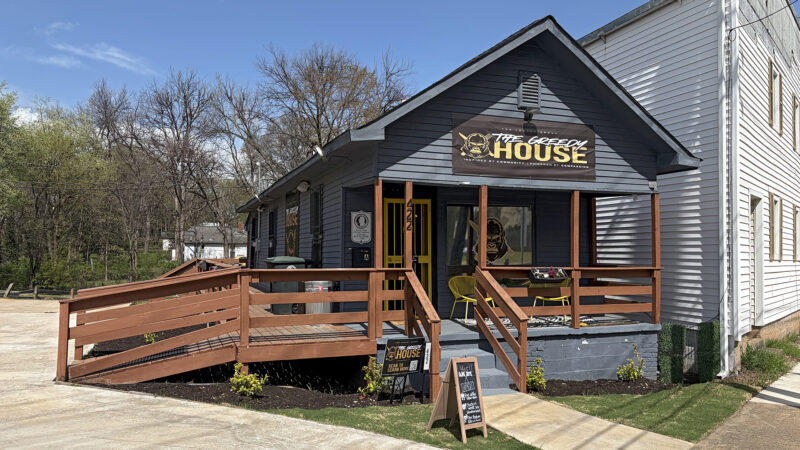
Auburn football player uses NIL funds to open a community hub in Birmingham
Jourdin Crawford, a freshman defensive lineman at Auburn, used earnings from a Name, Image, and Likeness deal to give back to his hometown.
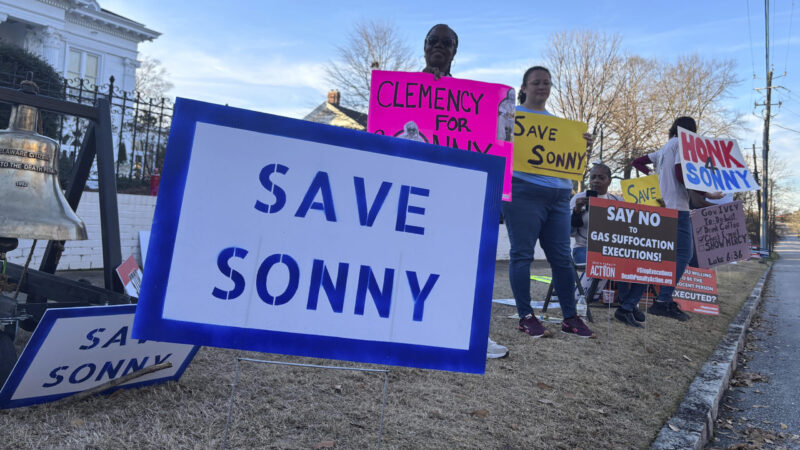
Ivey commutes death sentence of inmate whose accomplice fired fatal shot
Charles “Sonny” Burton was sentenced to death for the killing of Doug Battle during a 1991 robbery. However, another man shot Battle when Burton had left the building.