
Slavery is on the ballot in Alabama and 4 other states

By Kimberlee Krusi, Associated Press
NASHVILLE, Tenn. — More than 150 years after slaves were freed in the U.S., voters in five states will soon decide whether to close loopholes that led to the proliferation of a different form of slavery — forced labor by people convicted of certain crimes.
None of the proposals would force immediate changes inside the states’ prisons, though they could lead to legal challenges related to how they use prison labor, a lasting imprint of slavery’s legacy on the entire United States.
The effort is part of a national push to amend the 13th Amendment to the U.S. Constitution that banned enslavement or involuntary servitude except as a form of criminal punishment. That exception has long permitted the exploitation of labor by convicted felons.
“The idea that you could ever finish the sentence ‘slavery’s okay when … ’ has to rip out your soul, and I think it’s what makes this a fight that ignores political lines and brings us together, because it feels so clear,” said Bianca Tylek, executive director of Worth Rises, a criminal justice advocacy group pushing to remove the amendment’s convict labor clause.
Nearly 20 states have constitutions that include language permitting slavery and involuntary servitude as criminal punishments. In 2018, Colorado was the first to remove the language from its founding frameworks by ballot measure, followed by Nebraska and Utah two years later.
This November, versions of the question go before voters in Alabama, Louisiana, Oregon, Tennessee and Vermont.
Sen. Raumesh Akbari, a Democrat from Memphis, was shocked when a fellow lawmaker told her about the slavery exception in the Tennessee Constitution and immediately began working to replace the language.
“When I found out that this exception existed, I thought, ‘We have got to fix this and we’ve got to fix this right away,’” she said. “Our constitution should reflect the values and the beliefs of our state.”
Constitutions require lengthy and technically tricky steps before they can be tweaked. Akbari first proposed changes in 2019; the GOP-dominant General Assembly then had to pass the changes by a majority vote in one two-year legislative period and then pass it again with at least two-thirds approval in the next. The amendment could then go on the ballot in the year of the next gubernatorial election.
Akbari also had to work with the state Department of Correction to ensure that inmate labor wouldn’t be prohibited under her proposal.
The proposed language going before Tennessean voters more clearly distinguishes between the two: “Slavery and involuntary servitude are forever prohibited. Nothing in this section shall prohibit an inmate from working when the inmate has been duly convicted of a crime.”
“We understand that those who are incarcerated cannot be forced to work without pay, but we should not create a situation where they won’t be able to work at all,” Akbari said.
Similar concerns over the financial impact of prison labor led California’s Democratic-led Legislature to reject an amendment eliminating indentured servitude as a possible punishment for crime after Gov. Gavin Newsom’s administration predicted it could require the state to pay billions of dollars at minimum wage to prison inmates.
Scrutiny over prison labor has existed for decades, but the 13th Amendment’s loophole in particular encouraged former Confederate states after the Civil War to devise new ways to maintain the dynamics of slavery. They used restrictive measures, known as the “Black codes” because they nearly always targeted Black people, to criminalize benign interactions such as talking too loudly or not yielding on the sidewalk. Those targeted would end up in custody for minor actions, effectively enslaving them again.
Fast-forward to today: Many incarcerated workers make pennies on the dollar, which isn’t expected to change if the proposals succeed. Inmates who refuse to work may be denied phone calls or visits with family, punished with solitary confinement and even be denied parole.
Alabama is asking voters to delete all racist language from its constitution and to remove and replace a section on convict labor that’s similar to what Tennessee has had in its constitution.
Vermont often boasts of being the first state in the nation to ban slavery in 1777, but its constitution still allows involuntary servitude in a handful of circumstances. Its proposed change would replace the current exception clause with language saying “slavery and involuntary servitude are forever prohibited in this State.”
Oregon’s proposed change repeals its exception clause while adding language allowing a court or probation or parole agency to order alternatives to incarceration as part of sentencing.
Louisiana is the only state so far to have its proposed amendment draw organized opposition, over concerns that the replacement language may make matters worse. Even one of its original sponsors has second thoughts — Democratic Rep. Edmond Jordan told The Times-Picayune/The New Orleans Advocate last week that he’s urging voters to reject it.
The nonprofit Council for a Better Louisiana warned that the wording could technically permit slavery again, as well as continue involuntary servitude.
Louisiana’s Constitution now says: “Slavery and involuntary servitude are prohibited, except in the latter case as punishment for a crime.” The amendment would change that to: “Slavery and involuntary servitude are prohibited, (but this) does not apply to the otherwise lawful administration of criminal justice.”
“This amendment is an example of why it is so important to get the language right when presenting constitutional amendments to voters,” the nonprofit group said in a statement urging voters to choose “No” and lawmakers to try again, pointing to Tennessee’s ballot language as a possible template.
Supporters of the amendment say such criticisms are part of a campaign to keep exception clauses in place.
“If this doesn’t pass, it will be used as a weapon against us,” said Max Parthas, state operations director for the Abolish Slavery National Network.
The question stands as a reminder of how slavery continues to bedevil Americans, and Parthas says that’s reason enough to vote yes.
“We’ve never seen a single day in the United States where slavery was not legal,” he said. “We want to see what that looks like and I think that’s worth it.”

Crew of fatal US military crash included Alabama father recently deployed
The six U.S. service members who died in the crash of a U.S. military refueling aircraft included an Alabama father who had just been promoted and deployed. The U.S. government released the identities of the deceased service members Saturday.
Alabama poised to drastically overhaul utility regulation. Will it lower electric bills?
The Alabama Senate unanimously voted to expand the public service commission, and create a Secretary of Energy to address rising electricity prices. A bill in the House would go even further, requiring rate case hearings and limiting utility profits.

Musher from Alabama is going for back-to-back Iditarod wins
Riches and paid appearances haven’t followed Jessie Holmes since he won the world’s most famous sled dog race, the Iditarod, last year. He doesn't mind.
Bill would move Alabama to closed primaries
Right now, any Alabama voter can participate in a primary election. Lawmakers in Montgomery took up a bill this week that would change that system.
Auburn football player uses NIL funds to open a community hub in Birmingham
Jourdin Crawford, a freshman defensive lineman at Auburn, used earnings from a Name, Image, and Likeness deal to give back to his hometown.
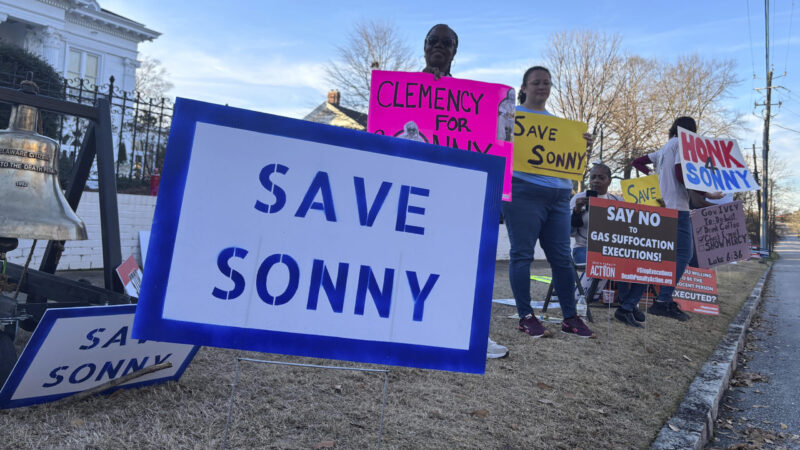
Ivey commutes death sentence of inmate whose accomplice fired fatal shot
Charles “Sonny” Burton was sentenced to death for the killing of Doug Battle during a 1991 robbery. However, another man shot Battle when Burton had left the building.