
Correspondence That Shaped the Jefferson County Courthouse Murals
Since last fall, the Jefferson County Commission has been debating what to do about murals in the foyer of the county courthouse.
The murals are massive — 17.5 feet by eight feet. As you enter, the mural on the right, named “The Old South,” depicts a white woman in profile standing resolutely amidst symbols of the bygone plantation era. There’s a steamboat and a white-columned plantation house. In the mural’s middle section, two white men, who seem to be overseers, ride horseback past a row of slave cabins, clutching whips. In the bottom of the panel, four slaves – three women and one man – harvest sugarcane and cotton from the fields.
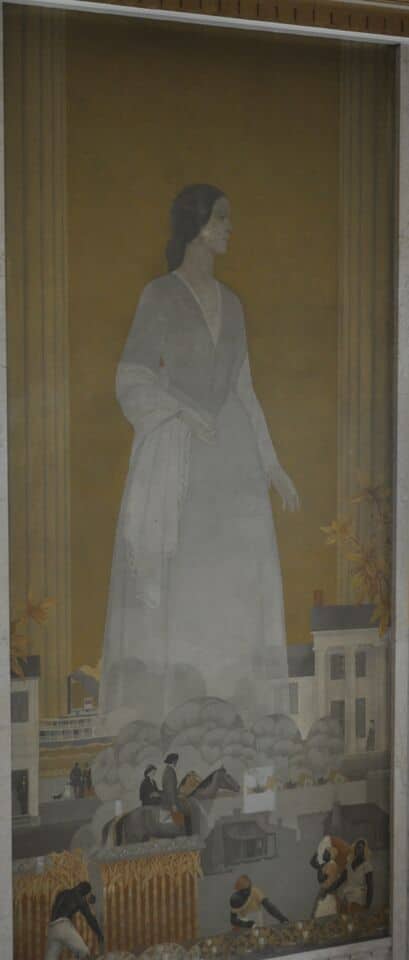
Ashley Cleek,WBHM
One of the 1930s-era murals in the Jefferson County Courthouse.
On the left side of the entryway is the other mural, called “The New South.” (Remember, it’s the 1930s.) It shows a massive, white man with what looks like plans unfurled in his hands. The city of Birmingham rises from a cloud of smoke at his feet. Shirtless, muscled white men stoke furnaces, while inside of what looks like a mine, a black worker shovels coal into a cart.
When the murals were commissioned, Birmingham was in high spirits. It was the 1930s, and the county was flush with cash. Construction on the new county courthouse cost $3 million, and the Jefferson County Commission wanted something to decorate their new building. So they commissioned John Norton, a well-known muralist, to paint two murals. Norton worked on the murals for about a year. As he was planning and sketching the murals, he would send updates to the county commissioners. Some commissioners would even visit his studio to check on the progress.
Below is the full correspondence between Norton, the Chicago architectural firm Holabird and Root, and the Jefferson County Commission.
In one of the first letters from Norton to the Jefferson County Commission in September 1931, it is clear the commission was already suggesting changes.
Norton answers:
“The decoration for the south panel (a woman’s figure) will be made approximately like the sketch submitted, with such minor changes as have been suggested, namely a change in character of the negro cabins, the head of the woman to be of a type satisfactory to the Commissioners, as expressing a Southern woman. It is understood that such changes in color and design to strengthen the large scale picture will be made.”
A few months later in December 1931, the secretary of the Jefferson County Commission, Herbert Salmon, wrote to John Holabird, a partner at the architecture firm, who commissioned Norton.
Salmon wrote:
“After several criticisms of a minor nature, which included the rather awkward appearance of the hands and the ‘Semitic nose,” the Commission decided to leave it to Mr. Root and Mr. Holabird’s discretion. I am sure that you and Mr. Norton will keep in mind that these murals are being placed in a building in the South, and that they are intended in one instance to portray the traditions and the agriculture and commercial activities of the Old South and in the other instance, the industrial developments of the New South, wherein the traditions of the Old South are still retained. […] The details in the lower foreground of the New South panel particularly need to be very carefully done. If they are in error to any great extent, they will be subjected to the criticism of a great many of the citizens, who generally speaking are quite familiar with the appearance of mines and industrial plants.”
Salmon further asked for Norton to submit pictures of the progress of his panels.
In January of 1932, County Commissioner Jack Smith wrote to Norton. He enclosed photos of “the type of mine car now used in this district,” so that Norton’s drawing would be accurate. He enclosed of photo of former Confederate General Major Milner and requested that he serve as the base of the image of the man in the New South mural.
Smith wrote that the commissioners still had some concerns about the murals:
“They are particularly interested in the faces of the large figure in each panel and seem somewhat concerned over the slightly Semitic cast of features which you have indicated on all sketches this far submitted showing these faces. They are relying upon you to produce two heads which will be brunette and indicating appropriate strength of character, but without any trace of the Semitic.”
Two days later, Salmon wrote Norton as well.
“Everyone immediately notices the face of the negro woman in the cotton field episode who wears a sun-bonnet. She looks more like a negro man. In fact, Mr. Salmon and I have examined this face under magnifying glass, and we both think she looks too much like a negro man. I believe the face is too striking to blend with the rest of the picture and suggest that you do something to make this head less noticeable.”
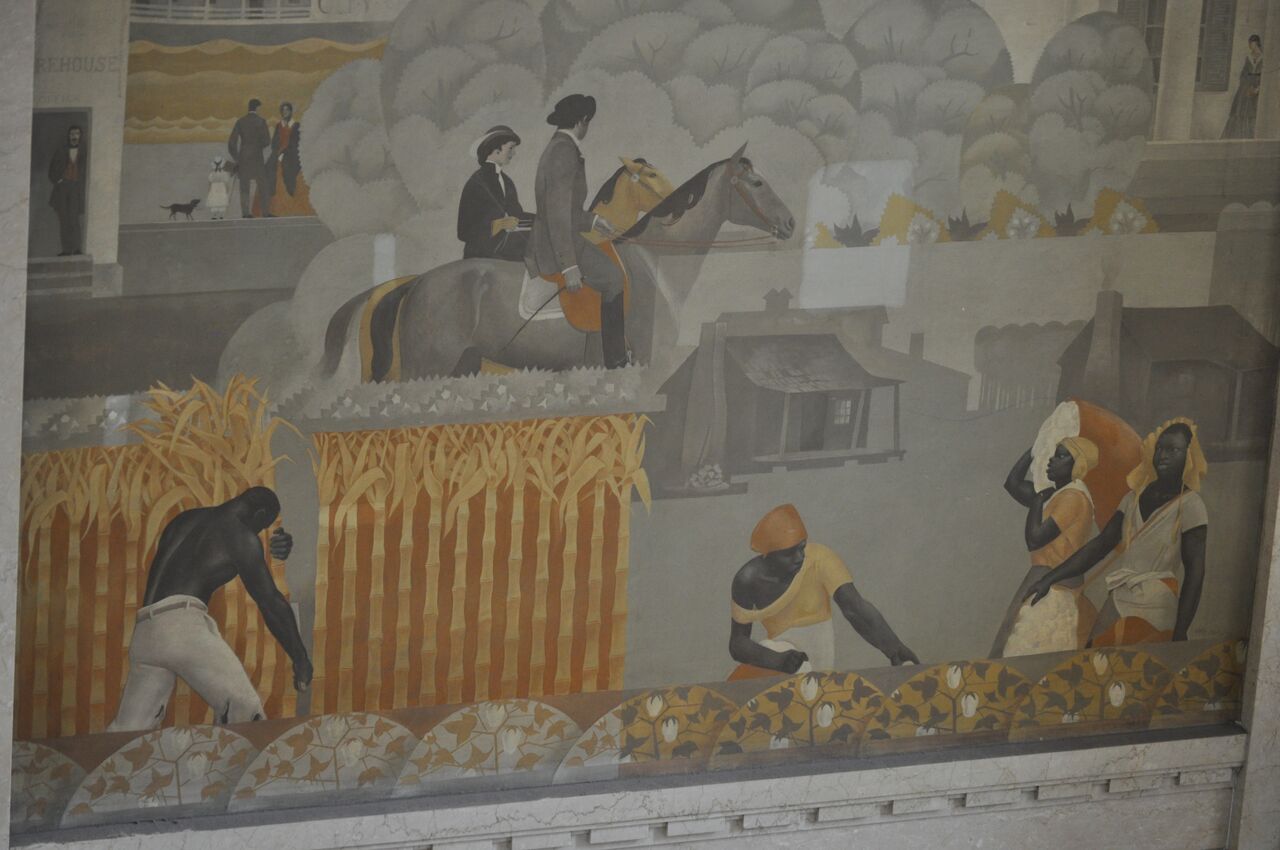
Ashley Cleek,WBHM
A detail of cotton pickers from the Jefferson County Courthouse murals.
Two days later, Salmon wrote Norton as well.
“There has been an almost unanimous criticism of the three Negro Cotton Pickers [sic]. The center negro figure is very good, but the two figures on the right and left, which are presumable female negro cotton pickers have been the subject of considerable criticism.”
In an undated, handwritten letter, Norton responded:
“Your letter just received with numerous criticisms has completely discouraged me from trying to satisfy the commission. […] The cotton pickers, in my opinion, are the best designed group I have ever done. And while the character if the negress in the sun bonnet can and will be changed, I cannot agree that these figures are masculine in their muscular development. The drawings were made from a colored girl – the intention was to have three [indecipherable] with the same face.”
Norton agreed to change the look of the figure of the white woman.
On March 14, 1932, Norton wrote Jack Smith (the two had become friendly over the course of a year).
“These pictures have gone slowly I know, but it is because every square inch of the workmanship and design has been gone over and over. If these are not successful in place, I’ll jump in whatever river you have in Birmingham.”
Ten days later, Smith responded, suggesting a few more changes:
“The mining experts say the timber prop shown in the mine is never square or oblong, it is always round. We therefore request that you make this minor change. […] Many people think the stevedore [n.b: a person employed to load and unload cargo] wheeling the cotton should be a colored man. Everyone thinks his clothing is much too neat for his job. I suggest that his clothing should be changed to that of a workman and that his color be changed to that of a mulatto.”
Jefferson County, Alabama Courthouse Murals Historic Information Packet

Crew of fatal US military crash included Alabama father recently deployed
The six U.S. service members who died in the crash of a U.S. military refueling aircraft included an Alabama father who had just been promoted and deployed. The U.S. government released the identities of the deceased service members Saturday.
Alabama poised to drastically overhaul utility regulation. Will it lower electric bills?
The Alabama Senate unanimously voted to expand the public service commission, and create a Secretary of Energy to address rising electricity prices. A bill in the House would go even further, requiring rate case hearings and limiting utility profits.

Musher from Alabama is going for back-to-back Iditarod wins
Riches and paid appearances haven’t followed Jessie Holmes since he won the world’s most famous sled dog race, the Iditarod, last year. He doesn't mind.
Bill would move Alabama to closed primaries
Right now, any Alabama voter can participate in a primary election. Lawmakers in Montgomery took up a bill this week that would change that system.
Auburn football player uses NIL funds to open a community hub in Birmingham
Jourdin Crawford, a freshman defensive lineman at Auburn, used earnings from a Name, Image, and Likeness deal to give back to his hometown.
Ivey commutes death sentence of inmate whose accomplice fired fatal shot
Charles “Sonny” Burton was sentenced to death for the killing of Doug Battle during a 1991 robbery. However, another man shot Battle when Burton had left the building.